
April 2026
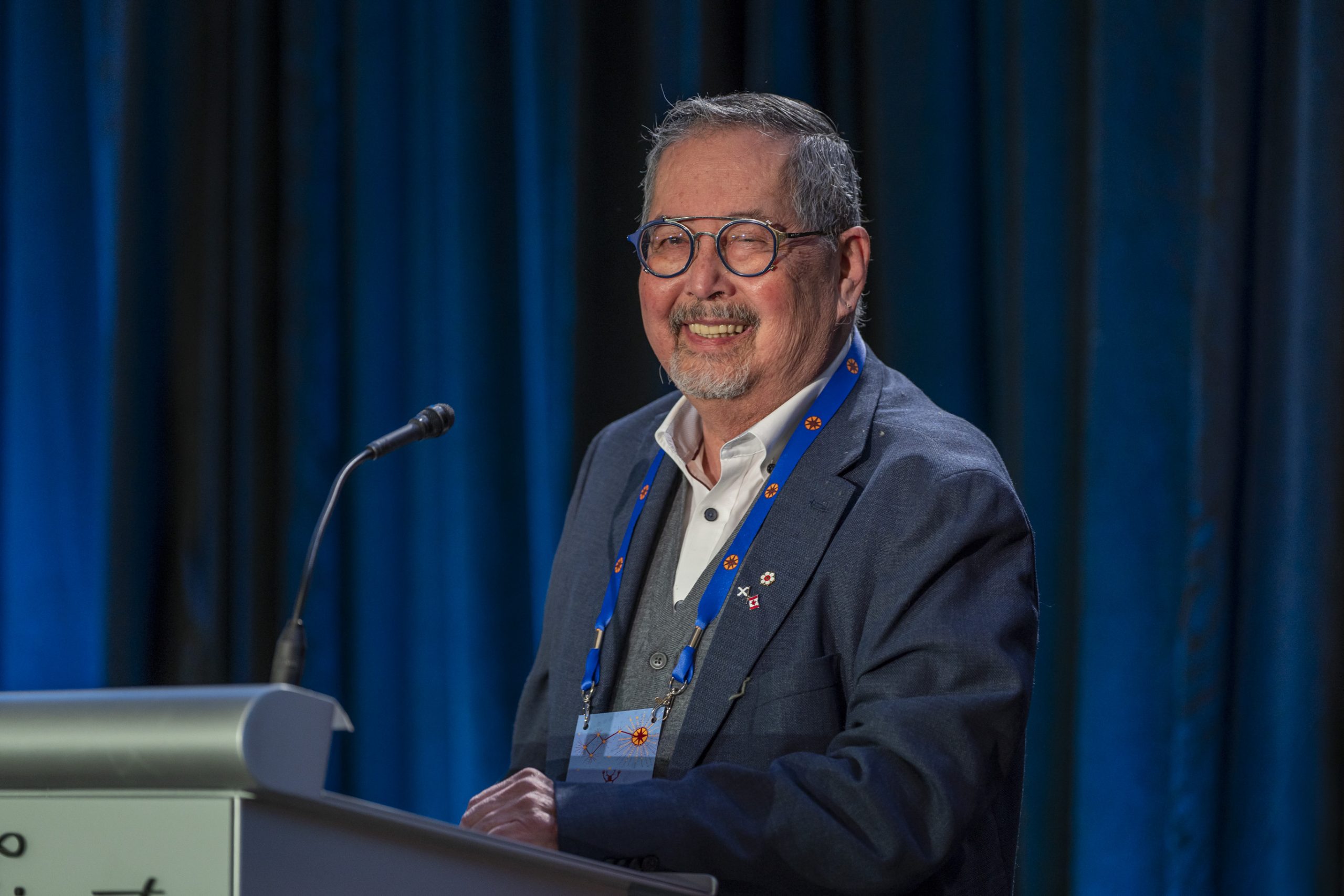
Remembering Howard E. Grant
Howard Grant passed away on March 29, 2026, at the age of 79. He was a deeply respected leader and a pillar in his community. He dedicated much of his adult life to public service, and his work had a deep and far-reaching impact. In addition to his many years on Musqueam council, and as Executive Director of the Musqueam Indian Band, Howard served more than 27 years as Executive Director of the First Nations Summit. He worked tirelessly in support of First Nation title, rights and jurisdiction. He strongly supported the creation of many of the institutions that serve First Nations in British Columbia and across Canada. Howard served on the First Nations Leadership Council, was a member of the BC Land Title Survey Authority Advisory Committee, and a member of the BC Children’s Hospital Foundation Board. He was appointed with the Order of British Columbia in 2024 and presented with the King Charles Coronation Medal in 2025.
“Howard was a very proud Coast Salish. His leadership and support of First Nation jurisdiction, fiscal powers and national institutions not only meant greater self-determination for Musqueam but for First Nations across Canada. For me, he was an inspirational and strong leader with an incredible long-house voice, a trusted mentor, a consummate team player, and a dear friend. He will be missed deeply. His legacy to his community and all First Nations will live forever,” said Chief Commissioner Jules.
We extend condolences to Howard’s family, colleagues, and all those impacted by his passing.
October 2025
September 2025
Notice of Annual Meeting
Pursuant to section 131 of the First Nations Fiscal Management Act, notice is hereby given that the First Nations Tax Commission Annual Meeting will be held on October 16, 2025 at 10:00 AM (PT).
The meeting will be held virtually. Registrants will receive instructions for participation prior to the annual meeting.
If you would like to register, please email mail@fntc.ca before October 9, 2025.
The annual report may be accessed on the First Nations Tax Commission’s website.
September 2024
Notice of Annual Meeting
Pursuant to section 131 of the First Nations Fiscal Management Act, notice is hereby given that the First Nations Tax Commission Annual Meeting will be held on November 1, 2024 at 11:00 AM (PT).
The meeting will be held virtually. Registrants will receive instructions for participation prior to the annual meeting.
If you would like to register, please email mail@fntc.ca before October 25, 2024.
The annual report may be accessed on the First Nations Tax Commission’s website.
September 2023
Notice of Annual Meeting
Pursuant to section 131 of the First Nations Fiscal Management Act, notice is hereby given that the First Nations Tax Commission Annual Meeting will be held on October 27, 2023 at 11:00 AM Pacific Time.
The meeting will be held virtually. Registrants will receive instructions for participation prior to the annual meeting.
If you would like to register, please email mail@fntc.ca before October 19, 2023.
The annual report may be accessed on the First Nations Tax Commission’s website.
January 2023
Remembering Chief William (Bill) Montour (1941–2023)
The First Nations Tax Commission greatly mourns the loss of former Chief William (Bill) Montour of the Six Nations of the Grand River, who passed away on January 8, 2023.
Chief Montour was born on Six Nations, the eldest of nine children. He served twice as the Elected Chief of Six Nations of the Grand River from 1986 to 1991, then again from 2007 to 2013. He also served as a councillor in 1976. Prior to his career in politics, he was an iron worker for many decades.
In 1989, Chief Montour was a founding member of the Indian Taxation Advisory Board, the predecessor institution to the First Nations Tax Commission. He served until 1994. He brought enormous leadership and credibility to that role at a time when First Nation taxation was not well understood and at times controversial. He was a leader of vision who looked long into the future and saw the potential to expand the role and powers of First Nation governments, and to use those powers to strengthen First Nation communities. Despite his towering frame, he conveyed great warmth, humour, and was always generous with his time and understanding – he was much loved by those who knew him.
The First Nations Tax Commission mourns his loss and sends sincere condolences to his wife Pam and the Montour family.
September 2022
March 2022
January 2022
Statement by Chief Commissioner C.T. (Manny) Jules on the passing of Chief Tom Bressette
It is with great sadness that we learned of the passing of Chief Tom Bressette. On behalf of everyone at the First Nations Tax Commission, I wish to send my deepest condolences to his family, the members of Chippewas of Kettle and Stony Point, and everyone lucky enough to call “Big Tom” a friend.
We fondly remember his larger-than-life presence, personality, laugh, voice, and leadership. But he also has left behind a larger-than-life legacy for his family, community, Ontario First Nations, and all Indigenous people in Canada. Tom was a munitions expert in the US Army. He was a skilled tradesman. He was an addictions counsellor. He was an entrepreneur. He served on the Kettle and Stony Point council for four years and was Chief for 19 years. He was the Assembly of First Nations Ontario Vice Regional Chief from 1997 until 2000.
I began to work on the AFN National Fiscal Relations Table with Chief Bressette while he was Ontario Vice Chief. Together we led the development and passage of the First Nations Fiscal and Statistical Management Act. His unwavering support for the FSMA (now FMA) was not popular in Ontario but he attended every meeting – always outnumbered by opponents – to fearlessly defend it as something that would benefit First Nations across Canada. The legislation passed in 2005 and is now used by over half of all First Nations in Canada, generating millions of dollars in First Nation community revenues, financing billions in infrastructure and community initiatives, and creating thousands of jobs.
Chief Bressette led his community through the lpperwash tragedy and the eventual settlement, which set a precedent for specific claims agreements for all First Nations in Canada. He re-established First Nation tax jurisdiction in 2016 for his community that not only helped improve community services, infrastructure, and financial management, but also set a precedent that is now being used by other Ontario First Nations. I will remember Chief Bressette as much more than a visionary and fearless leader. I will remember him for his kindness, sense of humor, wise counsel, and strength. He was the best type of friend you could have. When working with Tom he always had your back, and you felt like you could do anything. And, as is evident by his lengthy list of accomplishments, he did.
His family has lost a father, grandfather, brother, uncle, and cousin. The Chippewas of Kettle and Stony Point have lost a great Chief. First Nations across this country have lost his leadership. And so many of us have lost a good friend and a great man impossible to replace. He will be greatly missed. Safe journey my good friend.
Kukwstsetsemc,
C.T. (Manny) Jules
Chief Commissioner
First Nations Tax Commission
November 2021
Canadian Chamber of Commerce passes resolution to support the establishment of the First Nations Infrastructure Institute
Canadian Chamber of Commerce passes resolution to support the establishment of the First Nations Infrastructure Institute
July 2021
FNTC to Support Taxing First Nations with OSRICI Application
On June 9, 2021, Indigenous Services Canada (ISC) launched the “Own Source Revenue in Indigenous Communities Initiative” (OSRICI), designed to provide support to Indigenous communities that have suffered a decline in own-source revenue (OSR) due to the COVID-19 pandemic. OSR includes property taxes, local revenues and other First Nation government revenues from agreements, businesses, and other sources. The OSRICI is providing $332.8 million in funding to partially offset declines in own-source revenues so that First Nations, Inuit, and Métis communities can continue to provide important community programs and services.
The FNTC has agreed to support taxing First Nations in applying to the OSRICI program. In the coming weeks, the FNTC will be contacting your tax administrator to offer support with the application process.
The deadline for applications is August 31, 2021. ISC Regional Offices will review OSRICI applications and determine the amount of funding for which First Nations are eligible.
For more information, please contact the FNTC: OSRICI-support@fntc.ca
OSRICI website (link): https://www.sac-isc.gc.ca/eng/1623255117700/1623255147941
June 2021
Statement by Chief Commissioner C.T. (Manny) Jules regarding the discovery on the grounds of the former Kamloops Indian Residential School
Canadians are shocked and saddened by the discovery last week of the remains of 215 children buried on the site of the former grounds of the Kamloops Indian Residential School, located within the Tk’emlúps te Secwe̓pemc.
The offices of the First Nations Tax Commission are just a few hundred meters from this tragic grave site. I am certain this will now become a forensic investigation.
This school was under Roman Catholic administration from 1890 until 1969. In the 1950’s attendance peaked at 500 students. I attended this school, as did my parents, many of my relatives, and life-long friends.
Over the years, we had heard rumors of unmarked graves on the reserve and were misled to believe that the children had simply run away. These children would have been from my community and over 20 other communities representing five nations – the Secwepemc, Okanagan, Nlakapamux, St’at’imc and Tsilhqot’in.
This is a deeply personal matter for all of us. My community is in mourning and will grieve and honour these children. There are ceremonies taking place across the country and my heart is thankful for the care of these precious souls.
There are many questions that have long gone unanswered, and we hope that this will now change. Our prayers and thoughts are with the spirits of the young ones, the families affected by this tragedy, as well as other survivors of the residential school system.
Kukwstsétsemc,
C.T. (Manny) Jules
Chief Commissioner
First Nations Tax Commission
April 2021
October 2020
Canterbury and Canada combine in online Indigenous Economics course
A cohort of First Nations students from the Tulo Centre of Indigenous Economics in British Columbia, Canada, and students from the Ngāi Tahu Research Centre at the University of Canterbury, Aotearoa New Zealand, have been studying Indigenous Economics together virtually, in a pilot course.
The Ngāi Tahu Research Centre (NTRC) collaborated with the Tulo Centre to deliver a unique course in Indigenous Economics with 16 First Nation Canadian students joining a Ngāi Tahu cohort of 16 late last month.
“The idea was if this pilot was successful then we would work towards refining the course and looking to get future credits cross credited to UC,” says NTRC Director Associate Professor Te Maire Tau, who is also Ngāi Tūāhuriri Upoko.
Leading the Canadian side, C.T. (Manny) Jules is the Chief Commissioner of the First Nations Tax Commission based in Kamloops, British Columbia. He is a leading figure in getting Canada’s First Nations people independence over their tax affairs, and says tax autonomy forms a vital part in self-determination and entrepreneurship.
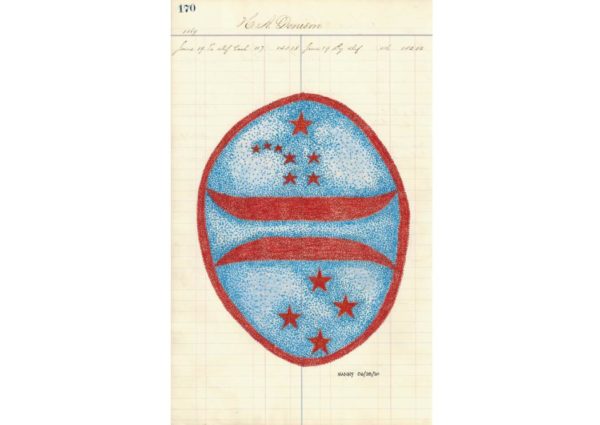
“We share the Pacific Ocean. We share the wealth, life and imagination the ocean has brought to our lands. The waka and the canoe, symbols of teamwork and determination, have brought us to new and different places. Our ancestors, shining through the North Star and Southern Cross, have connected us to work together and learn from one another,” he says.
“Market economies were not foreign to us. We created them ourselves. We traded goods over hundreds of miles. The Mayan had a complex trade network,” Jules says.
“How could pipestone, dating back to before contact end up in my territory in South Central British Columbia when it only comes from a few places such as Pipestone, Minnesota if we did not trade? How could corn be used all throughout the Americas before contact, if we did not trade?”
The pilot course, delivered via virtual delivery, is a foundational course in Tulo Centre’s Applied Economics Programme and included students from Indigenous communities in Canada and New Zealand. In the course, students investigated topics related to Indigenous self-governance and economic development globally, with particular focus on Canada and New Zealand. Topics included the impact of Covid-19 on Indigenous communities and economies; pre-contact Indigenous institutions, innovations and economies; the destruction of Indigenous institutions; systemic issues and gaps impacting Indigenous communities; the economic rationale for implementing Indigenous government and jurisdiction; Indigenous resource management; Indigenous fiscal powers; and creative destruction and the formula for change. The course was capped off with the Tulo Centre’s Building a Sustainable Indigenous Economy game.
- Manny Jules was interviewed on RadioNZ recently, talking about how he recovered 45,000 acres of his tribe’s reserve lands and how he’s driven legislative reform in the country.
- Part of the WORD Christchurch Spring Festival, Associate Professor Te Maire Tau joins fellow UC academics in discussing the new CUP book A Long Time Coming: The story of Ngāi Tahu’s treaty settlement negotiations, which shines a light, for both Māori and Pākehā, on a crucial part of this country’s history. Join the author UC Ngāi Tahu Research Centre Lecturer Dr Martin Fisher, along with UC Adjunct Professor Tā Tipene O’Regan, and former Minister for Treaty of Waitangi Negotiations Chris Finlayson, as they discuss a claim that spanned two centuries.
Tulo Centre of Indigenous Economics
The mission of the Tulo Centre of Indigenous Economics is to assist interested Indigenous governments in building legal and administrative frameworks that support markets on their lands. www.tulo.ca
Ngāi Tahu Research Centre
The Ngāi Tahu Research Centre (NTRC) was founded for the purpose of being a leader in Indigenous scholarship and to provide a centre for the intellectual capital and development of Ngāi Tahu, the principal Māori iwi of the southern region of New Zealand. https://www.canterbury.ac.nz/ntrc/
For further information please contact:
UC Communications
All media enquiries are directed to the UC Communications team.
Email media@canterbury.ac.nz for media enquiries (business hours, Monday – Friday)
Call 03 369 3631 for media enquiries (business hours, Monday – Friday)
Call 027 503 0168 for urgent media enquiries (after-hours, Monday – Sunday)
September 2020
Proposed Procedures Respecting the Approval of First Nation Local Revenue Laws, 2020
Procedures are established by the First Nations Tax Commission (Commission) to provide transparent and efficient processes for the approval of local revenue laws by the Commission to assist the Commission in fulfilling its statutory obligations under the First Nations Fiscal Management Act (the “Act”).
Under the Act, the Commission reviews and approves laws. Subsection 35(2) of the Act provides that the Commission may establish procedures respecting the “submission for approval” of local revenue laws and “approval of those laws.” In June 2009, the Commission approved the Procedures Respecting the Approval of First Nation Local Revenue Laws (Approval Procedures). They were further amended in September 2016.
As a matter of policy, the Commission seeks public input prior to introducing or significantly amending its Procedures. This input is critical in developing procedures that are efficient and acceptable for participating First Nations and their taxpayers.
Earlier this year, a review of the Approval Procedures was carried out to determine ways to improve clarity and remove unnecessary administrative requirements. As a result of this review, the Commission is proposing to replace the existing Approval Procedures.
Changes to the Approval Procedures include how the Commission may postpone law review where a law is non-compliant with the Act. Where a law review is postponed, a First Nation may amend an original law or replace it with a new law, and that the Commission may proceed with review and approval consideration of the amending law and original law, or a new law. The proposed Approval Procedures remove the requirement for the Commission to:
• notify the First Nation of the necessary amendments;
• advise the First Nation of whether identified amendments are not significant in the context of subsections 6(2) and 8(2) of the Act; and
• set a time frame for the making and submission of an amending law.
Additional changes include section 1.1 which is updated to clarify that the Commission will review “accompanying information required by section 8 of the Act” in its review and consideration of approval of the submitted law, and section 5, which would separate the provisions dealing with compliance of sections 6 and 8 of the Act.
The Commission is seeking public input in respect of these proposed Approval Procedures. If you wish to learn more about the proposed changes, please contact the FNTC at mail@fntc.ca or by telephone toll free at 1 (855) 682-3682. Electronic versions of the proposed Approval Procedures (changes are highlighted in red) are available at www.fntc.ca or by clicking the link below:
Proposed Procedures Respecting the Approval of First Nation Local Revenue Laws, 2020
Please direct your written comments on or before November 30, 2020 to:
First Nations Tax Commission
321-345 Chief Alex Thomas Way
Kamloops BC
V2H 1H1
Telephone: 1 (855) 682-3682
Fax: (250) 828-9858
Email: mail@fntc.ca

Chief Commissioner Speaks to Radio New Zealand
Chief Commissioner Jules discusses the importance of First Nation jurisdiction with Radio New Zealand Host, Julian Wilcox.
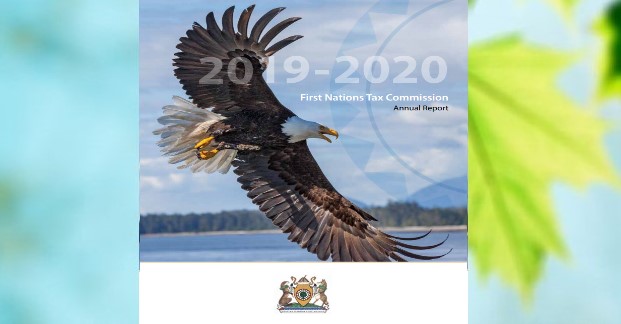
The First Nations Tax Commission Releases its 2019/20 Annual Report
The Annual Report provides an update to First Nations, taxpayers and the federal government on the FNTC’s progress in achieving its vision and highlighting how our work improves First Nation communities and supports expanding First Nation tax jurisdiction.
Download the Annual report.